Salou Ku'us al-Tila (Ask the Cups of Wine) سلوا كؤوس الطلا
1938 · Maqam Huzam
Salou Ku'us al-Tila (1938): Ahmed Shawqi's wine-song portrait of Umm Kulthum's own voice, set by Riad al-Sunbati in maqam Huzam — annotated and translated.
Era · 1934–1952
العصر الذهبي للإذاعة
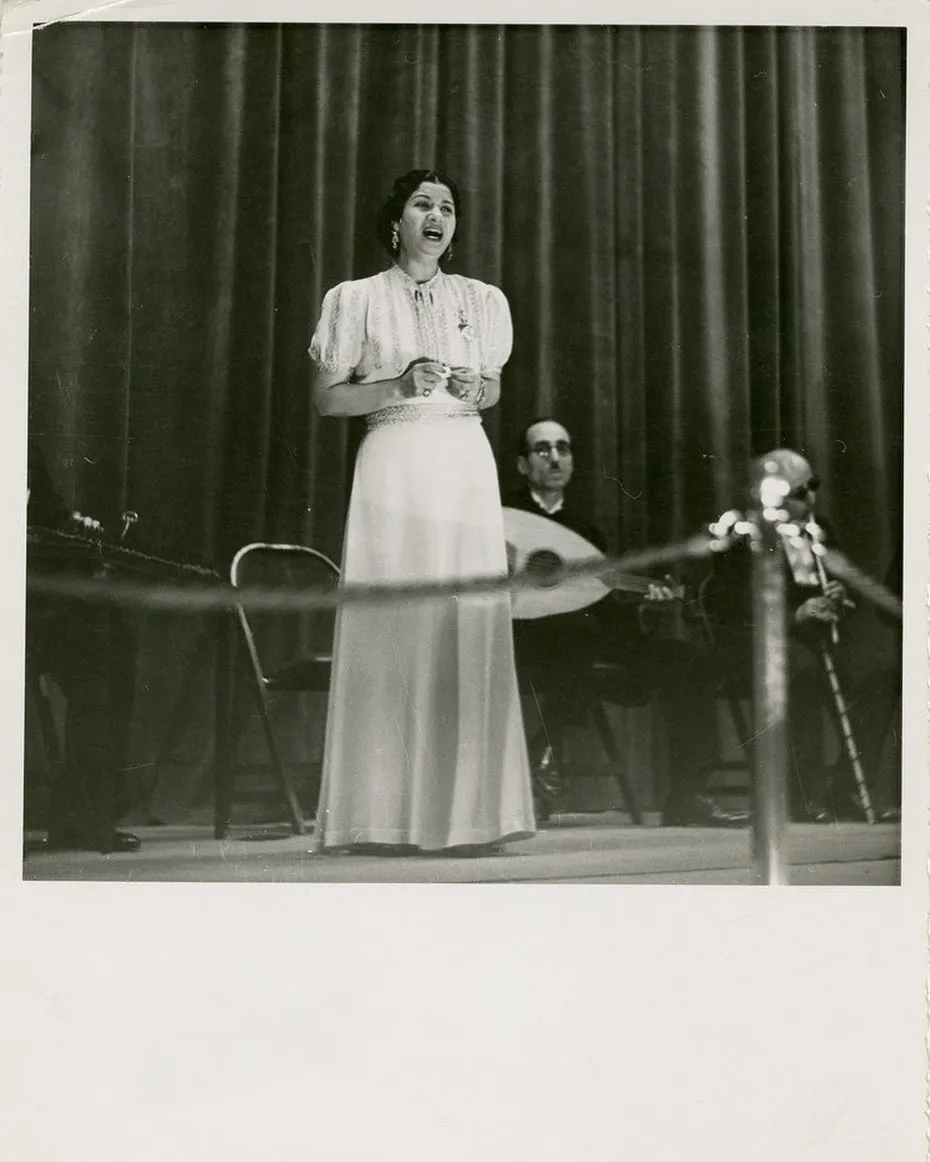
Egyptian State Radio began broadcasting on 31 May 1934, and within days her voice was on its air — a medium that might have been invented for her. Her live concerts on the first Thursday of each month grew into a pan-Arab ritual: cafés from Morocco to Iraq tuned in, and the streets themselves seemed to quiet. The era also made her a film star — six musical films between Widad (1936) and Fatma (1947) carried her voice to audiences who would never enter a Cairo concert hall. Artistically, the 1940s ran between two poles. With composer Zakariyya Ahmad and poet Bayram al-Tunisi she perfected the vernacular Egyptian song — "Ana Fi Intizarak" (1943), "Ghanni Li Shwayya" (1945) — while Riad Al-Sunbati's qasida settings raised her art to the high literary register. Elected president of the musicians' union in 1945, she now held institutional power to match her artistic authority. By the time the monarchy fell in July 1952, she was less a singer than a national institution: the voice of Egypt in fact, if not yet in title.


1938 · Maqam Huzam
Salou Ku'us al-Tila (1938): Ahmed Shawqi's wine-song portrait of Umm Kulthum's own voice, set by Riad al-Sunbati in maqam Huzam — annotated and translated.
1943 · Maqam Hijazkar
Ana Fi Entezarak (1943): full lyrics of Bayram al-Tunisi and Zakariyya Ahmad's vigil song — an absence counted second by second, with translation and notes.
1945 · Maqam Rast
Ghanni Li Shwayya (1945): full lyrics of Bayram al-Tunisi and Zakariyya Ahmad's ode to song itself, from the film Sallama — with translation and notes.
1946 · Maqam Rast
Salou Qalbi (1946): Ahmed Shawqi's qasida in Sunbati's maqam Rast — the song that made 'goals are never attained by wishing' the proverb of a generation.
1949 · Maqam Rast
Wulida al-Huda (1949): Shawqi's mawlid hymn in Sunbati's maqam Rast — the boldest verses on faith, justice and equality Umm Kulthum ever sang.
1946 · Maqam Rahat al-Arwah
Nahj al-Burda (1946): Shawqi's answer to al-Busiri's Burda, set by Sunbati in maqam Rahat al-Arwah — the most exalted of Umm Kulthum's prophetic praise songs.
1950 · Maqam Rast
Rubaiyat el-Khayyam (1950): Omar Khayyam in Ahmed Rami's Arabic, set by Riad al-Sunbati in maqam Rast — meaning and translation of Umm Kulthum's masterpiece.
1951 · Maqam Huzam
Ila Arafat Allah (1951): Ahmed Shawqi's Hajj qasida in Riad al-Sunbati's maqam Huzam setting — how Umm Kulthum's pilgrimage anthem came to be, with translation.
1951 · Maqam Rast
Misr Tatahaddath An Nafsiha (1951): full lyrics & translation of Hafez Ibrahim's qasida in Riad al-Sunbati's maqam Rast setting — Egypt speaks in her own voice.