Songs
سلوا كؤوس الطلا Salou Ku'us al-Tila (Ask the Cups of Wine)
- Year
- 1938
- Lyricist
- Ahmed Shawqi
- Composer
- Riad Al-Sunbati
- Maqam
- Huzam
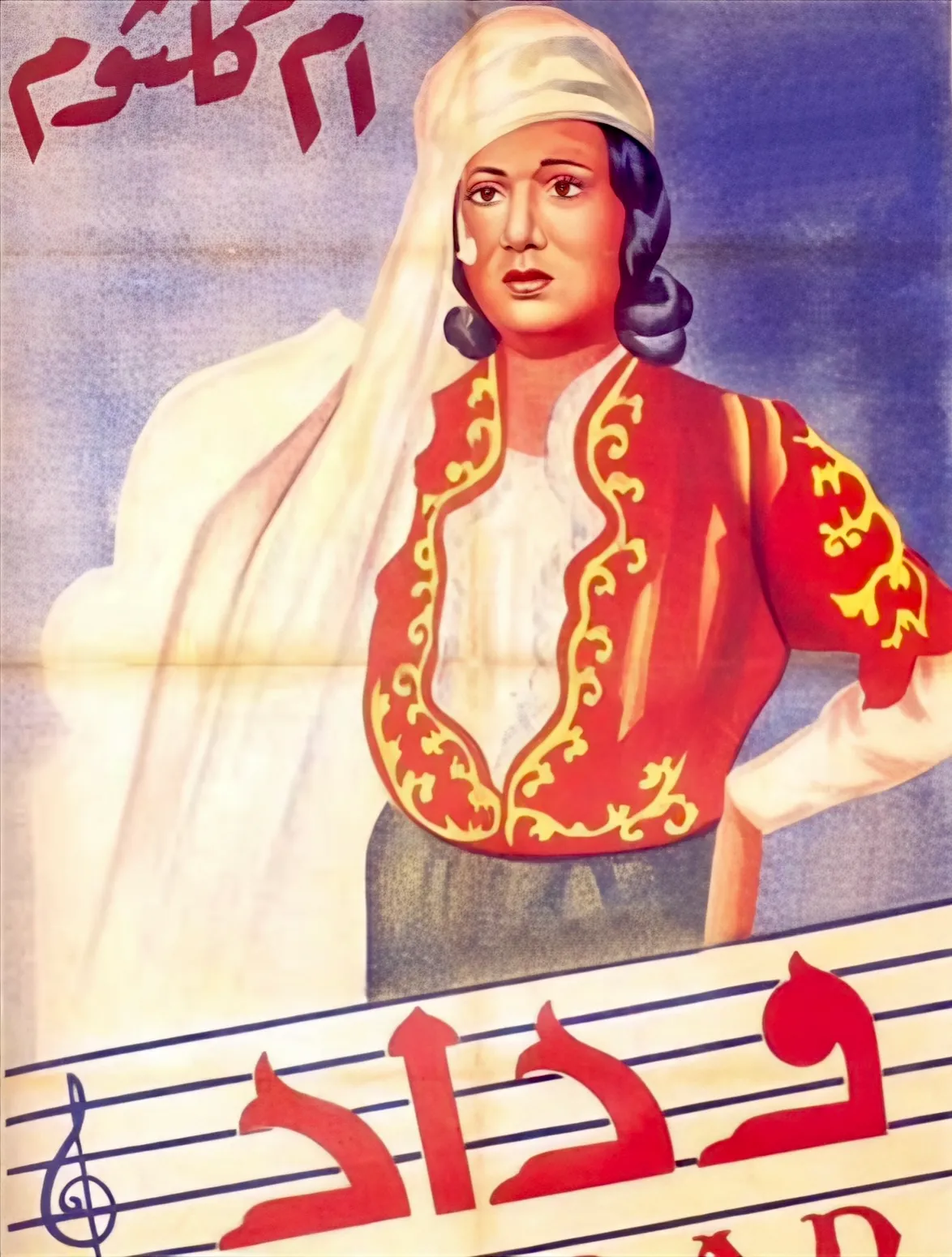
Lines marked with a gold ornament carry a note — select one to read it.
سلوا كؤوسَ الطِّلا هل لامستْ فاها
Salu ku'usa t-tila hal lamasat faha
Ask the cups of wine: did they ever touch her mouth?
The opening plants the song squarely in the khamriyya, the Arabic wine-song tradition running from the Abbasid libertines to the Sufi mystics — then reverses its polarity. Classically the drinker seeks the wine; here the cups themselves are interrogated for the privilege of having touched her lips. The beloved does not taste the wine; she consecrates it. Shawqi keeps the genre's glamour and discards its dissipation in a single courtly turn.
The poem's journey to the stage was the slowest in her repertoire. In October 1932, days before his death, Shawqi sent the text to the young Riad al-Sunbati with his blessing; the composer later recalled living with it for years before the setting satisfied him. Umm Kulthum premiered it in 1938, in maqam Huzam — the solemn, quarter-tone-shaded mode Sunbati would make the signature of his grandest qasidas.
واستخبروا الراحَ هل مسّتْ ثناياها
Wa-stakhbiru r-raha hal massat thanayaha
Question the drink itself: did it graze her teeth?
باتتْ على الروضِ تسقيني بصافيةٍ
Batat 'ala r-rawdi tasqini bi-safiyatin
All night in the garden she poured me a clear draught
لا للسُّلافِ ولا للوردِ ريّاها
La li-s-sulafi wa-la li-l-wardi rayyaha
whose fragrance was neither the vintage's nor the rose's.
ما ضرَّ لو جعلتْ كأسي مراشفَها
Ma darra law ja'alat ka'si marashifaha
What harm, had she made her lips my cup —
The boldest line Shawqi permits himself: what harm if her lips had been my cup? The conditional "law" — if only — does all the work, desiring everything while claiming nothing. It is the decorum of the classical ghazal: audacity conducted entirely in the subjunctive, and Umm Kulthum delivers it with a lightness that lets the audacity pass as grace.
ولو سقتْني بصافٍ من حُميّاها
Wa-law saqatni bi-safin min humayyaha
had she poured me the pure wine of her own warmth?
هيفاءُ كالبانِ يلتفُّ النسيمُ بها
Hayfa'u ka-l-bani yaltaffu n-nasimu biha
Slender as the willow-branch, the breeze winds about her,
ويُلفتُ الطيرَ تحتَ الوشيِ عطفاها
Wa-yulfitu t-tayra tahta l-washyi 'itfaha
and beneath the embroidered silk her grace turns the birds' heads.
حديثُها السحرُ إلا أنه نغمٌ
Hadithuha s-sihru illa annahu naghamun
Her speech is sorcery — except that it is melody,
The famous verse, and the reason this poem matters to her biography: her speech is sorcery, except that it is song, as if it had run upon the lips of David — the prophet whose psalms are the tradition's very figure of divinely beautiful music. By widespread account Shawqi wrote the poem after hearing Umm Kulthum sing at his villa, Karmat Ibn Hani; the "enchantress" of the qasida is the woman who would one day sing it. She is, in effect, performing her own portrait.
جرتْ على فمِ داودَ فغنّاها
Jarat 'ala fami Dawuda fa-ghannaha
as though it ran upon David's lips, and he sang it.
حمامةُ الأيكِ من بالشجوِ طارحَها
Hamamatu l-ayki man bi-sh-shajwi tarahaha
Dove of the thicket: who traded songs of sorrow with her?
Mid-poem, the beloved dissolves into a dove of the thicket — the classical Arabic emblem of the voice that grieves beautifully. The questions ("who taught her sorrow? who whispered longing to her?") are the questions every listener asked about Umm Kulthum herself: where does a voice like that learn its ache? Shawqi's answer is the oldest one — from the night, and from love.
ومن وراءَ الدجى بالشوقِ ناجاها
Wa-man wara'i d-duja bi-sh-shawqi najaha
Who, from beyond the darkness, whispered longing to her?
ألقتْ إلى الليلِ جيدًا نافرًا ورمتْ
Alqat ila l-layli jidan nafiran wa-ramat
She offered the night a startled throat, and turned
An astonishingly exact picture of a singer in performance: the lifted, startled throat, the ear turned as if listening to the dark, the unfocused eyes. Anyone who has watched film of Umm Kulthum mid-qasida has seen precisely this posture. The poet describes the dove; the description is a portrait from the concert hall.
إليهِ أذنًا وحارتْ فيهِ عيناها
Ilayhi udhnan wa-harat fihi 'aynaha
an ear toward it, her eyes lost wandering in it;
وعادَها الشوقُ للأحبابِ فانبعثتْ
Wa-'adaha sh-shawqu li-l-ahbabi fa-nba'athat
then longing for the beloved seized her, and she rose,
تبكي وتهتفُ أحيانًا بشكواها
Tabki wa-tahtifu ahyanan bi-shakwaha
weeping, crying out at moments her complaint.
يا جارةَ الأيكِ أيامُ الهوى ذهبتْ
Ya jarata l-ayki ayyamu l-hawa dhahabat
O neighbor of the thicket — the days of love are gone
كالحلمِ آهًا لأيامِ الهوى آها
Ka-l-hulmi ahan li-ayyami l-hawa aha
like a dream. Ah, for the days of love — ah!
The poem ends on a sigh made into language — "ahan... aha" — and Sunbati, understanding the gift, makes the sigh the melodic destination of the entire work. In performance, including the celebrated evening at the Royal Opera House in November 1944, Umm Kulthum would return to the final line again and again, each "aha" placed differently — the purest demonstration that in tarab the wordless syllable can outweigh the sentence.
What this song means
Among the hundreds of texts Umm Kulthum sang, “Salou Ku’us al-Tila” occupies a position no other can claim: it is, by widespread account, a poem about her — written by the greatest poet of the age after he heard her sing, and then placed in her own mouth. When she performs it, the portrait and the sitter merge. The “enchantress” whose speech is sorcery, whose voice seems to have run upon the lips of David, is the woman holding the microphone.
The story behind it has the shape of a bequest. Ahmed Shawqi, the “Prince of Poets,” had kept a certain courtly distance from Umm Kulthum through the 1920s, while his salon at Karmat Ibn Hani embraced her rival Mohammed Abdel Wahab. But near the end of his life the admiration surfaced: he heard her, wrote these nine verses, and in October 1932 — days before his death — sent the poem to the young Riad al-Sunbati to compose. Sunbati lived with the text for years, unwilling to release a setting that fell short of it. The song finally reached the public in 1938, in maqam Huzam, and became one of the works that established him as the supreme composer of the sung qasida; a celebrated performance at the Royal Opera House in November 1944 fixed it in concert legend.
The poem itself is a khamriyya — a wine song — that overturns its own tradition in the first breath. For a millennium, Arabic poets had praised the cup; Shawqi instead puts the cups under interrogation: ask them whether they ever touched her mouth. The wine is not the intoxicant here, and neither, quite, is the woman — it is her voice. The description ascends deliberately: first the swaying figure that tangles the breeze, then speech that is revealed to be melody, then the great compliment of the David verse, in which her singing is placed beside the psalms — as close as a love poem can come to calling a voice holy.
In the final movement the beloved becomes a dove of the thicket, the classical emblem of beautiful grieving, and the poem quietly turns into a portrait of a singer at work: the lifted throat offered to the night, the ear inclined as if listening to the dark, the wandering eyes, the sudden welling of longing that breaks into open complaint. Shawqi ends by writing the sigh itself into the text — “ah, for the days of love, ah” — and Sunbati, recognizing what he had been given, built the entire melodic arc to land on that syllable. Night after night, Umm Kulthum would re-place the final “aha” differently, proving the central paradox of tarab: the wordless sound, properly placed, can say more than the sentence that prepared it.
It is tempting to hear the whole work as Egyptian music passing itself a torch. A dying poet describes a voice; a young composer spends six years learning to deserve the description; and the voice itself, singing the result, confirms everything the poem claims about it. Few songs anywhere are so perfectly circular — a masterpiece about the very gift that performs it.
Related songs
All songsAna Fi Entezarak (I Am Waiting for You) أنا في انتظارك
1943 · Maqam Hijazkar
Ana Fi Entezarak (1943): full lyrics of Bayram al-Tunisi and Zakariyya Ahmad's vigil song — an absence counted second by second, with translation and notes.
Ya Msaharni (You Who Keep Me Sleepless) يا مسهرني
1972 · Maqam Rast
Ya Msaharni (1972): Sayed Mekawy's only melody for Umm Kulthum and Ahmed Rami's last lyric — a sleepless reproach in maqam Rast. Excerpts and commentary.
Nahj al-Burda (The Way of the Mantle) نهج البردة
1946 · Maqam Rahat al-Arwah
Nahj al-Burda (1946): Shawqi's answer to al-Busiri's Burda, set by Sunbati in maqam Rahat al-Arwah — the most exalted of Umm Kulthum's prophetic praise songs.
Salou Qalbi (Ask My Heart) سلوا قلبي
1946 · Maqam Rast
Salou Qalbi (1946): Ahmed Shawqi's qasida in Sunbati's maqam Rast — the song that made 'goals are never attained by wishing' the proverb of a generation.
From the wiki
All articlesConcepts
Understanding Maqam
A plain-language guide to the maqam system — quarter tones, sayr, and tarab — through four maqams heard in Umm Kulthum's songs: Rast, Kurd, Huzam, Farahfaza.
Concepts
Where to Start with Umm Kulthum: A Listener's Guide
New to Umm Kulthum? A step-by-step listening guide: which songs to start with, from Enta Omri to Al-Atlal, and how to enjoy her hour-long live tarab recordings.
Concepts
The Art of the Qasida
The qasida — the classical Arabic ode — was the most prestigious form Umm Kulthum sang. A guide through Salou Qalbi, Al-Atlal, the Rubaiyat, and Nahj al-Burda.