Songs
الحب كله El Hob Kollo (All the Love)
- Year
- 1971
- Lyricist
- Ahmad Shafiq Kamel
- Composer
- Baligh Hamdi
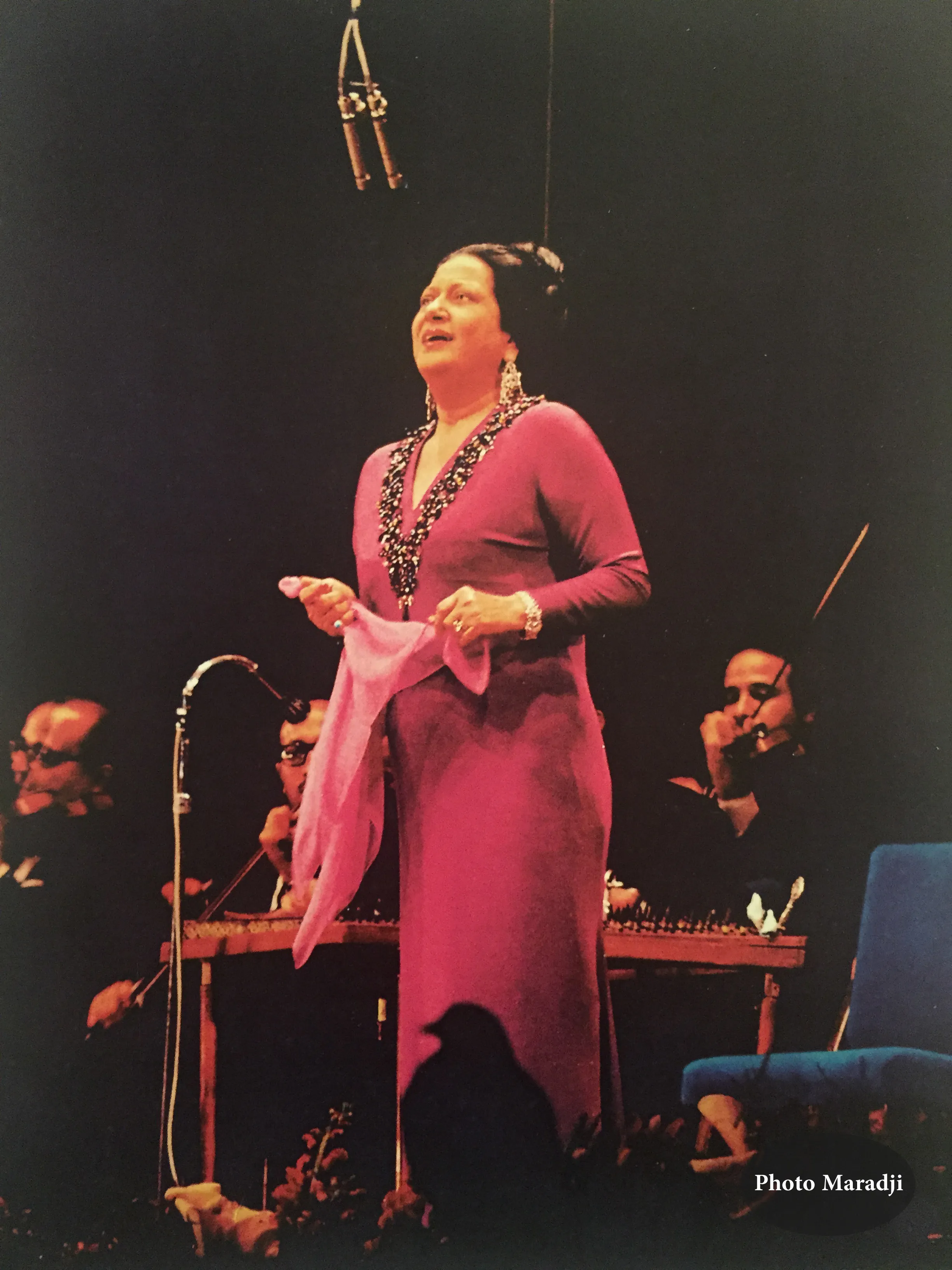
Short excerpts are quoted here for commentary and study; the complete lyrics remain under copyright. The annotations and the essay below tell the whole story.
Lines marked with a gold ornament carry a note — select one to read it.
الحب كله حبيته فيك، الحب كله
El-hobb kollo habbeito fik, el-hobb kollo
All the love there is, I loved it in you — all the love
The title line is an audit with only one entry: all the love that exists, spent on a single person; all of time, lived for him. Ahmad Shafiq Kamel — the poet of "Enta Omri" — returns to his great theme, the arithmetic of a lifetime, and pushes it past hyperbole into totality. The doubled "kollo" (all of it) at each line's end works like a seal pressed twice.
Premiered on 7 January 1971 at the Qasr el-Nil cinema in Cairo and carried by radio across the Arab world. It was Umm Kulthum's first concert after three months of mourning for Gamal Abdel Nasser, who had died the previous September — a return the press treated as national news. A song insisting that life is love, and nothing else, was offered to a country that badly needed permission to feel joy again.
وزماني كله أنا عشته ليك، زماني كله
W zamani kollo ana 'eshto lik, zamani kollo
And all my days, I lived them for you — all my days
واسقيني واملا واسقيني تاني
W es'ini w emla w es'ini tani
Pour for me, fill the cup, pour for me again —
"Pour for me, fill the cup, pour again" — the cupbearer of classical Arabic wine poetry summoned into a colloquial love song, with love itself in the goblet. Baligh Hamdi built the melody of this refrain as a returning cycle, an invitation the hall answered every time; in performance it became the song's engine of repetition and the audience's favorite demand.
من الحب، منك، من نور زماني
Men el-hobb, mennak, men nour zamani
Of love, of you, of the light of my days
اسقيني ياللي من يوم ما شفتك
Es'ini yalli men yom ma shoftak
Pour, you who — from the day I first saw you —
حسيت كأني اتخلقت تاني
Hasseit ka'enni etkhala't tani
Made me feel I had been created anew
أنا كنت إيه قبل ما أشوفك، أنا كنت إيه
Ana kont eih abl ma ashoufak, ana kont eih
What was I, before I saw you — what was I?
"What was I before I saw you?" reprises, almost a decade later, the central argument of "Enta Omri" by the same lyricist: the time before love is not merely inferior but unaccountable — a question with no answer. Kamel lets the singer audit her own existence and find nothing on the books until the beloved appears.
وكنت عايش يا حبيبي أيامي ليه
W kont 'ayesh ya habibi ayyami leih
And why, my love, was I even living my days?
طريق حياتي مشيته قبلك في ليل طويل
Tari' hayati mesheito ablak fe leil tawil
I walked my life's road before you through a long night
The road walked "through a long night" with no heart alongside — the lyric's one extended image of the loveless past. Night here is not the beloved's night of vigil, as in so much of her repertoire, but blank time: distance without witness. It sets up the excerpt's final movement, where time itself becomes the adversary.
لا قلب جنبي يحس بيا ولا طيف جميل
La alb gambi yehess beyya wala teif gamil
No heart beside me to feel me, no beautiful shadow near
خبيني من الزمن خبيني
Khabbini men el-zaman khabbini
Hide me from time itself, hide me
"Hide me from time" — the plea that gives the song its late-period gravity. After totalized love and recovered joy comes fear: that time will take the great happiness, or take the singer from it. Sung in 1971 by a woman past seventy, before an audience that had just buried its president, the line landed as more than romance — and her performances leaned into its urgency rather than away from it.
وبعيد عن عيونه داريني
W be'id 'an 'oyouno darini
Keep me sheltered, far from its eyes
عالفرحة الكبيرة يا خوفي لا ياخدها ولا يخليني
'Al-farha el-kbira ya khofi la yakhodha wala ykhallini
I fear for this great joy — that time will take it, or take me from it
What this song means
On 28 September 1970 Gamal Abdel Nasser died, and Egypt’s voice fell silent with Egypt. Umm Kulthum — who had sung for the July regime, raised hard currency for the war effort after 1967, and mourned Nasser as a personal loss — stopped performing for three months; contemporary accounts say she weighed retirement itself. Her return came on Thursday, 7 January 1971, at the Qasr el-Nil cinema in Cairo, carried live by radio across the Arab world. The new song that anchored the evening was “El Hob Kollo” — All the Love — words by Ahmad Shafiq Kamel, music by Baligh Hamdi, who came early to the hall that night to supervise the final touches on his score.
Kamel was the poet of “Enta Omri,” and this lyric is that song’s argument grown older and more absolute. Where 1964 declared that life begins with the beloved, 1971 completes the audit: all the love there is, loved in one person; all of time, lived for him. The colloquial doubling — “el-hobb kollo… zamani kollo” — presses the seal twice on each line. The past is a road walked “through a long night,” with no heart alongside and no beautiful shadow near; the question “what was I before I saw you?” expects, and receives, no answer. In Kamel’s arithmetic a life is measured by nothing except its love.
The refrain turns that philosophy into ritual. “Pour for me, fill the cup, pour again — of love, of you, of the light of my days”: the cupbearer of the classical Arabic wine ode is summoned into an Egyptian colloquial love song, the goblet filled with love rather than wine, and being seen for the first time is described as a second creation. Baligh Hamdi shaped the passage as a returning cycle made for the concert hall — each reprise a fresh pour, each pour demanded by the audience. A story told in the Arab press holds that he adapted the melodic germ of the introduction from “Ashiqtuhu,” a song by the Saudi singer Fawzi Mahsoun — the kind of magpie borrowing, whether or not one credits every detail, that fit Baligh’s famously absorbent ear for popular melody across the region.
Then comes the shadow that gives the song its late gravity: “Hide me from time itself, hide me… I fear for this great joy — that time will take it, or take me.” The adversary of this love song is not a rival or the beloved’s coldness but time, named plainly. Sung by a woman past seventy to a country just out of mourning, the plea carried a double meaning no listener missed. The great joy was the music itself, and everyone in the hall understood how much time was left.
“El Hob Kollo” became one of the last summits of the Umm Kulthum–Baligh Hamdi partnership that had begun with “Hob Eih” in 1960, a companion piece to “Alf Leila wa Leila” in his late, expansive manner: long instrumental spans, cyclical refrains engineered for repetition, joy insisted upon at scale. It endures because its celebration is not innocent. The song knows what it is holding, and how briefly — which is why the fullest declaration of love in her late repertoire ends, in the passage quoted here, with a request to be hidden.
Related songs
All songsAlf Leila wa Leila (One Thousand and One Nights) ألف ليلة وليلة
1969 · Maqam Farahfaza
Alf Leila wa Leila (1969): Baligh Hamdi's nocturne for Umm Kulthum — maqam Farahfaza, the night-long refrain, and why one night outweighs a thousand and one.
Ya Msaharni (You Who Keep Me Sleepless) يا مسهرني
1972 · Maqam Rast
Ya Msaharni (1972): Sayed Mekawy's only melody for Umm Kulthum and Ahmed Rami's last lyric — a sleepless reproach in maqam Rast. Excerpts and commentary.
Hadhihi Laylati (This Is My Night) هذه ليلتي
1968 · Maqam Bayati
Hadhihi Laylati (1968): George Jardaq's qasida set by Abdel Wahab in maqam Bayati — the night Umm Kulthum returned to the Cairo stage after 1967. Meaning & translation.
Amal Hayati (Hope of My Life) أمل حياتي
1965 · Maqam Kurd
Amal Hayati (1965): Ahmad Shafiq Kamel's plea to stay inside love's dream, set by Abdel Wahab in maqam Kurd — meaning, translation & the story of its premiere.
From the wiki
All articlesConcepts
Where to Start with Umm Kulthum: A Listener's Guide
New to Umm Kulthum? A step-by-step listening guide: which songs to start with, from Enta Omri to Al-Atlal, and how to enjoy her hour-long live tarab recordings.
History
The Legacy of Umm Kulthum
Umm Kulthum's legacy since 1975: monthly radio broadcasts, praise from Bob Dylan, the Cairo museum on Roda Island, hologram concerts, and streaming rediscovery.
The Ensemble
The Takht and the Orchestra
How Umm Kulthum's accompaniment grew from the five-player takht — oud, qanun, nay, violin, riqq — into the sweeping firqa heard on her later recordings.