Nobody warns you about the sheer size of it. Umm Kulthum’s catalogue spans half a century, her greatest songs routinely run past the hour mark, and any streaming search returns a dozen versions of each — live, studio, remastered, truncated. Faced with all that, many curious listeners press play on something at random, hear ten minutes of orchestral introduction, and quietly give up. This guide exists to prevent that. It offers a path: a handful of songs in a deliberate order, and, just as importantly, a briefing on how this music expects to be heard.
First, Learn the Rules of the Game
Umm Kulthum’s mature songs are not three-minute statements; they are evenings. A single work may run thirty minutes in a compact rendition and well past an hour in concert. From 1937 her live seasons followed a famous rhythm — a concert on the first Thursday of every month, broadcast on Egyptian radio, in a season running from autumn to early summer — and a night typically held only two or three songs, each unfolded at enormous length.
The length is not padding. It is the mechanism of tarab, the Arabic term for the state of ecstatic absorption that this music aims to produce. Umm Kulthum would sing a line, then sing it again — and again — each time altering the ornament, the emphasis, the color, while the audience answered with cries and applause and demands for one more pass. A line repeated eight times is not the same line eight times; it is eight readings of a single thought, and the audience’s reaction steered which reading came next. This is why the live recordings matter so much: the repetition, the risk, and the crowd are the performance. Studio versions — tighter, cleaner, with no audience to answer — are useful maps, but the live recordings are the territory. A good rule for a newcomer: start with whatever version you find, and once a song has its hooks in you, seek out a full-length concert recording of it and hear what the same material becomes with an audience in the room.
One practical note before the itinerary: do not feel obliged to sit reverently through a full hour on day one. Her own audiences arrived knowing the poems and waiting for specific moments. Let the long introductions wash past, listen in stretches, return often. This music rewards familiarity more than stamina.
The Gateway: Enta Omri
Begin where the modern Arab world begins: Enta Omri (“You Are My Life”), premiered in February 1964. It was the first fruit of her long-awaited collaboration with the composer Mohammed Abdel Wahab — an event the Egyptian press hailed as a meeting of the two giants of Arabic music — with a colloquial love lyric by Ahmed Shafik Kamel. The famous electric-guitar figure in the opening announces its modernity at once, and the melody is the most immediately graspable in her late repertoire. If one song converts newcomers, it is this one. Listen for the way she leans into the refrain differently on each return; that is your first taste of tarab in action.
The Masterpiece: Al-Atlal
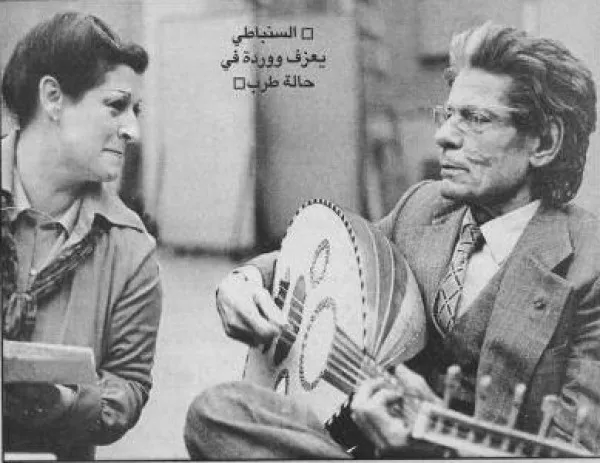
Once Enta Omri has opened the door, go to the summit. Al-Atlal (“The Ruins,” 1966) sets the poetry of Ibrahim Nagi — the sung text draws on more than one of his poems — to music by Riad al-Sunbati, the composer who understood her voice more deeply than anyone. Where Enta Omri charms, Al-Atlal devastates: a long meditation on love remembered among its ruins, culminating in a cry for freedom that Arab audiences after 1967 heard as something much larger than romance. Many critics, and many ordinary listeners, simply call it the greatest Arabic song of the twentieth century. Give it a quiet hour and full attention at least once.
The Youthful Turn: The Baligh Hamdi Songs
Now change the mood entirely. In the 1960s, already in her sixties, Umm Kulthum took on the young composer Baligh Hamdi and, with him, a lighter, more rhythmic, unmistakably youthful sound. Sirat El Hob (“The Mention of Love,” 1964), with lyrics by Morsi Gamil Aziz, swings where the qasidas soar; its refrain is pure joy, and audiences roared for its repetitions. Baeed Anak (“Away from You,” 1965), to a lyric by Ma’mun al-Shinnawi, is the tender counterpart — colloquial, intimate, direct. These songs answer the suspicion that Umm Kulthum is only solemn grandeur. She could be young at any age.
The Sacred Voice: The Religious Qasidas
Umm Kulthum was raised on Qur’anic recitation, and her diction and phrasing carried that training forever. Hear where it shows most plainly in the religious qasidas she made with al-Sunbati on poems by Ahmed Shawqi, the “Prince of Poets.” Salou Qalbi (“Ask My Heart,” 1946) is the essential first choice: classical Arabic delivered with a jeweler’s precision, every consonant placed. Wulida al-Huda (“The Guidance Is Born”), from the late 1940s, celebrates the Prophet’s birth with the same command. Even listeners with no Arabic report that these performances communicate their gravity directly. They are also the best place to hear the pure instrument — the voice with the least adornment around it.
The Late Monuments
Finish the itinerary at the far end of the career. Aghadan Alqak (“Shall I See You Tomorrow?”, 1971) sets a poem by the Sudanese poet Al-Hadi Adam to music by Abdel Wahab — classical verse carried on a huge, modern orchestra, the two poles of her art finally fused. Ya Msaharni (“You Who Keep Me Sleepless,” 1972), composed by Sayed Mekawy to a lyric by her lifelong poet Ahmed Rami, is among the last songs she premiered: an aging voice, still utterly in command, singing about sleeplessness and longing with the economy of someone who has nothing left to prove. Coming to these after the earlier stops, you will hear what the decades built.
A Note on Recordings and Versions
Her earliest records were 78s made for the gramophone companies of the 1920s and 1930s; the mature concert repertoire survives mainly through radio recordings, issued for decades by Egypt’s state label Sono Cairo (Sawt al-Qahira) and now scattered across streaming platforms in transfers of wildly uneven quality and labeling. Expect the same title at 35 minutes in one upload and 70 in another: these are different concert nights, not edits, and comparing them is one of the deep pleasures of this repertoire. When in doubt, prefer the longest live version with audible audience reaction — and treat any crisp, short, applause-free track as the studio map rather than the living performance.
Where to Go Next
Eight songs in, you will no longer need an itinerary; you will have preferences. Follow the composer you loved most — Sunbati’s depth, Abdel Wahab’s spectacle, Baligh’s pulse — into the rest of the catalogue, and read her biography to put the voice in its history. The archive of songs on this site is arranged to help. The only real mistake a new listener can make is hurrying; this is music that repays every hour you give it, and it has been converting the unconvinced for a hundred years.