Most famous deaths are private losses that the public is invited to observe. A very few are the other thing: public events so large that the private loss almost disappears inside them. When Umm Kulthum died in Cairo on 3 February 1975, the Arab world produced one of the largest funerals in recorded history — a crowd so vast, and so unwilling to let her go, that it physically took the funeral away from the state that had organized it. What follows is the story of her last years, the day itself, and what Cairo has done with her memory since.
The Long Decline
Her body had been negotiating with her fame for decades. From the late 1940s she suffered from a thyroid condition generally identified as Graves’ disease, which affected her eyes and sent her abroad for treatment — including surgery in the United States in 1953 — and which gave her the heavy dark glasses that became part of her public image. In her final decade the more dangerous trouble was her kidneys: chronic inflammation that specialists in Europe and the United States managed but never cured, even as she carried the punishing schedule of her post-1967 fundraising campaign described in Voice of the Nation.
The public could measure the decline only indirectly, because she refused to perform it. Her late premieres kept their monumental scale — Aghadan Alqak in 1971, set for her by Mohammed Abdel Wahab, and Ya Msaharni in 1972, the last new song she carried onto a stage. At a concert in December 1972 she was visibly unwell mid-program; characteristically, she finished the evening. It proved to be her final public performance. She was not finished working: in March 1973 she recorded Hakam Alayna al-Hawa, a melody by the young Baligh Hamdi, in a single marathon studio session. The concert that was to premiere it was cancelled, and the recording became her last. By late 1974, after further treatment abroad, she was said to be recovering. On 21 January 1975 a severe kidney attack put her in a Cairo hospital, and this time there was no recovery. She died at dawn on Monday, 3 February 1975, of kidney failure, in her seventies — her exact age uncertain, because the village of her birth had never firmly recorded the date.
How the News Was Told
Egyptian radio broke into its programming with Qur’anic recitation before the announcement — the sequence every listener of that era knew how to read — and stations across the Arab world followed, setting aside their schedules for recitation and for her own recordings. The front pages the next morning treated her death as the leading news from Rabat to Baghdad, and it was reported around the world; Time magazine ran its account under the title “Funeral for a Nightingale.” What happened next had no real precedent for a private citizen: airlines added flights and the railways added trains as mourners converged on Cairo from across Egypt and the Arab countries, and Arab kings and heads of state sent condolences to President Sadat as though a ruler had died.
Wednesday, 5 February: The Funeral
The state planned a grand but orderly farewell. On the morning of 5 February the funeral prayer was held at the Omar Makram Mosque on Tahrir Square — Cairo’s mosque of official mourning — led by the deputy prime minister and minister of religious endowments, with Prime Minister Abdel Aziz Hegazy, the speaker of parliament, ministers, and Arab ambassadors at the head of the cortège. Her body had been washed, by her family’s account, with water from Mecca sent by a Saudi prince, and the procession was to move with protocol dignity before the coffin travelled to the family tomb in the southern cemetery.
The crowd had other intentions. Estimates of its size begin around a million in the contemporary Western press and run to the figure of four million that Egyptians themselves settled on — by any count the largest gathering in the country’s history, exceeding even the funeral of President Nasser five years earlier. The mourners broke through the cordons, lifted the bier off the shoulders of its official bearers, and carried it themselves, hand over hand above the sea of people, chanting “There is no god but God” and “Farewell, voice of the people.” For some three hours the procession belonged to the street, forced off its planned route and steered toward the old city — most accounts say toward al-Azhar, the mosque popular retellings describe as her favorite; others name the neighboring shrine-mosque of al-Husayn. Only after that long detour was the coffin recovered so that it could be driven south to burial. Egyptians like to note the comparison the day invited: the state had buried a president in 1970, and the people, in 1975, buried a singer — more grandly.
Al-Basatin: The Grave and the Mausoleum
She was buried in the family tomb in al-Basatin, within the Imam al-Shafi’i cemetery district of Cairo’s historic southern necropolis — the City of the Dead, where the capital has buried its saints, scholars, and singers for a thousand years. A year after her death, at the request of the Ministry of Culture, a proper mausoleum was raised over the grave: an imposing Egyptian-revival structure set back from the street, one of the largest in the district, with a reception room inside where a tomb-keeper long kept a guest book for visitors. For decades admirers came, Egyptians and Gulf visitors especially; travellers in recent years have reported quieter courtyards, a chained gate, and signs of neglect — a fate the mausoleum shares with much of the old necropolis around it.
The Anniversaries
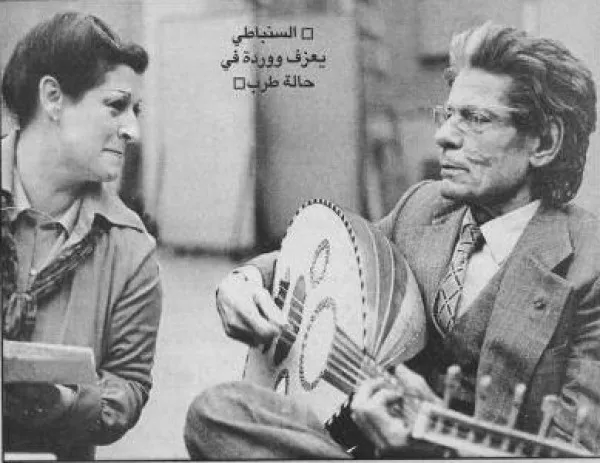
The mourning never fully ended; it became a calendar. Egyptian radio kept a standing tradition of broadcasting her concerts on the first Thursday evening of the month — the slot her live performances had owned for decades, as told in First Thursday Concerts — and the anniversary of 3 February is still marked each year with broadcasts, retrospectives, and tribute concerts. In 2001 the Egyptian state opened a museum devoted to her on Roda Island in Cairo, gathering her dresses, her famous sunglasses, manuscripts, and medals; in recent years she has even been returned to the stage as a hologram before audiences born long after 1975. The composers who outlived her — Abdel Wahab, Riad al-Sunbati — kept writing, but everyone understood that the institution they had written for was gone. What remains is what the crowd was mourning in the first place: the recorded voice, from Al-Atlal backward and forward, still on the air, still gathering the audience her funeral revealed. Her life before that final week is told in Umm Kulthum: A Life.