Salou Ku'us al-Tila (Ask the Cups of Wine) سلوا كؤوس الطلا
1938 · Maqam Huzam
Salou Ku'us al-Tila (1938): Ahmed Shawqi's wine-song portrait of Umm Kulthum's own voice, set by Riad al-Sunbati in maqam Huzam — annotated and translated.
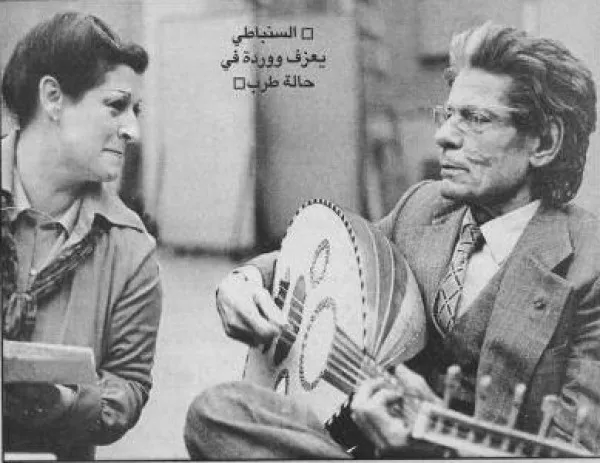
Composer
رياض السنباطي
1906–1981
No composer shaped Umm Kulthum's art more deeply than Riad Al-Sunbati. Born in the Delta town of Farskur and trained on the oud — his playing remains a benchmark for the instrument — he wrote for her across five decades: by most counts around ninety works, more than any other composer. His domain was the qasida, the classical Arabic poem sung at full length: settings of Ahmad Shawqi such as "Salou Qalbi" and "Nahj al-Burda," the Rubaiyat of Omar Khayyam in Ahmed Rami's translation, and above all "Al-Atlal" (1966), widely held to be the summit of her entire repertoire. "Hayyart Albi Maak" (1961) shows his more intimate romantic vein. Sunbati's signature is architecture: long forms that unfold with inevitable logic, modulations timed like dramatic reveals, and ornament pruned to exactly what the text requires. Where others chased fashion, he perfected tradition — and in doing so gave her voice its most enduring monuments.
1938 · Maqam Huzam
Salou Ku'us al-Tila (1938): Ahmed Shawqi's wine-song portrait of Umm Kulthum's own voice, set by Riad al-Sunbati in maqam Huzam — annotated and translated.
1946 · Maqam Rahat al-Arwah
Nahj al-Burda (1946): Shawqi's answer to al-Busiri's Burda, set by Sunbati in maqam Rahat al-Arwah — the most exalted of Umm Kulthum's prophetic praise songs.
1946 · Maqam Rast
Salou Qalbi (1946): Ahmed Shawqi's qasida in Sunbati's maqam Rast — the song that made 'goals are never attained by wishing' the proverb of a generation.
1949 · Maqam Rast
Wulida al-Huda (1949): Shawqi's mawlid hymn in Sunbati's maqam Rast — the boldest verses on faith, justice and equality Umm Kulthum ever sang.
1950 · Maqam Rast
Rubaiyat el-Khayyam (1950): Omar Khayyam in Ahmed Rami's Arabic, set by Riad al-Sunbati in maqam Rast — meaning and translation of Umm Kulthum's masterpiece.
1951 · Maqam Huzam
Ila Arafat Allah (1951): Ahmed Shawqi's Hajj qasida in Riad al-Sunbati's maqam Huzam setting — how Umm Kulthum's pilgrimage anthem came to be, with translation.
1951 · Maqam Rast
Misr Tatahaddath An Nafsiha (1951): full lyrics & translation of Hafez Ibrahim's qasida in Riad al-Sunbati's maqam Rast setting — Egypt speaks in her own voice.
1955 · Maqam Shahnaz
Shams el-Aseel (1955): full lyrics & translation of Bayram al-Tunisi's Nile sunset idyll, set by Riad al-Sunbati in maqam Shahnaz for Umm Kulthum.
1959 · Maqam Kurd
Hagartak (1959): Ahmed Rami's paradox of forgetting, set by Riad al-Sunbati in maqam Kurd — meaning and translation of Umm Kulthum's 'I left you' explained.
1960 · Maqam Ajam
Lissa Faker (1960): Riad al-Sunbati sets Abdel Fattah Mustafa's proud refusal for Umm Kulthum — 'that was long ago.' Annotated excerpts and essay.
1961
Hayyart Albi Maak (1961): Ahmed Rami and Riad al-Sunbati's late collaboration with Umm Kulthum — a study in longing, concealment, and live tarab practice.
1965 · Maqam Kurd
Araka 'Asiyy al-Dam' (1965): Abu Firas al-Hamdani's captivity qasida in Riad al-Sunbati's maqam Kurd setting — annotated lyrics, translation, and its story.
1966 · Maqam Huzam
Al-Atlal (1966): full lyrics of Ibrahim Nagi's qasida in Sunbati's maqam Huzam — with the seven spliced verses of 'Al-Wada'', translation and line notes.
History
Once a month, on the first Thursday, the Arab world stopped: the story of Umm Kulthum's live radio concerts and the ritual they became.
History
Umm Kulthum's legacy since 1975: monthly radio broadcasts, praise from Bob Dylan, the Cairo museum on Roda Island, hologram concerts, and streaming rediscovery.
The Ensemble
How Umm Kulthum's accompaniment grew from the five-player takht — oud, qanun, nay, violin, riqq — into the sweeping firqa heard on her later recordings.
Biography
The life of Umm Kulthum: from a Nile Delta village and Quranic training to Cairo's radio age, the national concerts, and the funeral of the century.
History
Umm Kulthum died on 3 February 1975. Her final illness, the Cairo funeral that drew millions, the seized bier, her Basatin mausoleum, and the Arab world's mourning.
Concepts
A plain-language guide to the maqam system — quarter tones, sayr, and tarab — through four maqams heard in Umm Kulthum's songs: Rast, Kurd, Huzam, Farahfaza.
History
How Umm Kulthum became inseparable from Egyptian national feeling — patriotic repertoire, post-1967 fundraising tours, and the weight of Umm al-Dunya.
Concepts
New to Umm Kulthum? A step-by-step listening guide: which songs to start with, from Enta Omri to Al-Atlal, and how to enjoy her hour-long live tarab recordings.
History
The complete Umm Kulthum songs list, decade by decade from 1924 to 1973: every recorded song with its year, lyricist, and composer — nearly 320 works in all.
Concepts
The qasida — the classical Arabic ode — was the most prestigious form Umm Kulthum sang. A guide through Salou Qalbi, Al-Atlal, the Rubaiyat, and Nahj al-Burda.
The Ensemble
The composers behind Umm Kulthum: Qasabgi, Zakariyya Ahmad, Riad al-Sunbati, Mohammed Abdel Wahab, and Baligh Hamdi — and the sound each one gave her.
Concepts
What made Umm Kulthum's voice extraordinary — her contralto range, Quranic training, breath control, tarab, and the art of singing one line a dozen different ways.