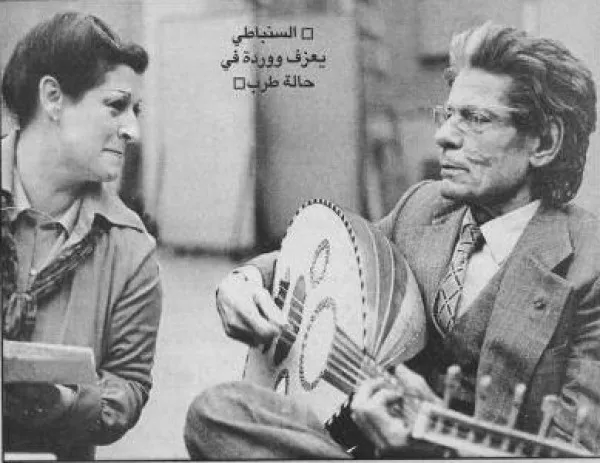
People who never understood a word of Arabic wept at Umm Kulthum’s records. That fact points at something the lyrics alone cannot explain: an instrument, and a technique for using it, of rare and specific power. Her voice was not simply beautiful. It was built — trained from childhood, disciplined, and deployed with a control that let her hold thousands of people suspended for the better part of an hour.
The Instrument
By classification Umm Kulthum was a contralto, the lowest and darkest of the female registers, though such European labels sit awkwardly on Arab music. Her usable range spanned roughly two and a half octaves, and — more telling than the span — the voice kept its full strength and color from bottom to top, with none of the thinning most singers show at their extremes. Contemporaries marveled at its sheer power: in the years of primitive amplification she is said to have stood a good distance back from the microphone, because the equipment of the day distorted when she sang into it at full voice.
Trained on the Quran
The foundation of that technique was not the concert stage but the mosque. As a girl in her Delta village she was taught in the kuttab, the traditional Quran school, and learned to recite — she is said to have memorized the Quran itself. Quranic recitation, tajwid, is an exacting oral discipline: it governs the exact articulation points of every letter (makharij al-huruf), the length of vowels, and the management of breath across long, unbroken passages. Everything that later made her diction so admired — the crystalline clarity of her classical Arabic, the way an educated audience could follow every word of a dense qasida — grew from this early training. Her first public performances were of religious texts, and the discipline never left her singing.
Breath and the Long Line
Anyone listening for it can hear the breath control. Umm Kulthum could ride a single melodic phrase to a length that seems physically impossible, sustaining a note while the ensemble held beneath her, releasing it only when she — not the meter, not the clock — decided. This is the technical bedrock of her most famous effect: the enormous, patient line that keeps an audience waiting for a resolution she withholds and withholds and finally grants.
The Art of Repetition
The single most misunderstood thing about her singing is the repetition. To a newcomer it can seem she is simply repeating a line over and over. In truth she never sang a line the same way twice. Each return reshaped the phrase — a different stress, a darker color, a note bent a fraction deeper into the maqam — so that a single verse of Al-Atlal might be turned over ten or fifteen ways, each version finding another shade of the words’ meaning.
This was improvisation, but of an unusual kind. Where an instrumentalist improvises on abstract melody, Umm Kulthum improvised on meaning: every variation was another reading of the text, another angle on the emotion. She was, in this sense, interpreting the poem in real time, and the repetitions were not padding but the whole substance of the art.
Tarab: The Voice and the Crowd
None of this happened in isolation. Her repetitions were a live negotiation with the hall. When she delivered a line that struck home, the audience roared, and that roar was permission — even instruction — to sing it again, further, deeper. This feedback loop is the engine of tarab, the state of shared musical ecstasy her whole tradition exists to produce. It is why a song printed as a few minutes of verse could expand, in performance, to thirty or forty, and why no two performances of the same song were ever alike. Every concert was, in the strict sense, a unique event, improvised into being between one voice and thousands of listeners.
Color and Emotion
Within the long lines she commanded a palette of vocal colors: a forward, faintly nasal resonance prized in Arab singing; a chest voice she carried through nearly her whole range; and, at the peaks of feeling, a deliberate catch or roughness in the voice — a controlled break that signaled overwhelming emotion without ever losing pitch or control. Whether in the earthy warmth of a Zakariyya Ahmad tune like Ghanni Li Shwayya or the vast romantic sweep of Enta Omri, the technique served one end: to make the feeling in the words audible, and then to make it unbearable, and then to release it. That is what the weeping was about.